

Dimensional Analysis With Scientific Notation

The addition x + a on the number line. All numbers greater than x and less than ten + a fall within that open interval.
In mathematics, a (real) interval is a set up of existent numbers that contains all existent numbers lying between any ii numbers of the set up. For example, the set of numbers x satisfying 0 ≤ x ≤ one is an interval which contains 0, 1, and all numbers in between. Other examples of intervals are the set of numbers such that 0 < x < 1, the set of all real numbers , the set of nonnegative real numbers, the fix of positive real numbers, the empty set, and any singleton (set of one chemical element).

Real intervals play an important role in the theory of integration, because they are the simplest sets whose "length" (or "measure out" or "size") is easy to define. The concept of measure can and so be extended to more complicated sets of real numbers, leading to the Borel measure out and eventually to the Lebesgue measure.
Intervals are primal to interval arithmetic, a general numerical computing technique that automatically provides guaranteed enclosures for arbitrary formulas, even in the presence of uncertainties, mathematical approximations, and arithmetic roundoff.
Intervals are likewise defined on an arbitrary totally ordered set, such as integers or rational numbers. The note of integer intervals is considered in the special section below.
Terminology [edit]
An open up interval does not include its endpoints, and is indicated with parentheses.[ane] For instance, (0,ane) means greater than 0 and less than i. This ways (0,1) = {ten | 0 < x < ane}. This interval tin can also exist denoted by ]0,i[, come across below.
A airtight interval is an interval which includes all its limit points, and is denoted with foursquare brackets.[one] For example, [0,one] means greater than or equal to 0 and less than or equal to one.
A one-half-open interval includes only i of its endpoints, and is denoted by mixing the notations for open and closed intervals.[2] For instance, (0,1] means greater than 0 and less than or equal to ane, while [0,ane) means greater than or equal to 0 and less than 1.
A degenerate interval is whatever ready consisting of a single real number (i.due east., an interval of the course [a,a]).[ii] Some authors include the empty set in this definition. A real interval that is neither empty nor degenerate is said to be proper, and has infinitely many elements.
An interval is said to be left-bounded or right-bounded, if there is some real number that is, respectively, smaller than or larger than all its elements. An interval is said to be divisional, if it is both left- and right-divisional; and is said to be unbounded otherwise. Intervals that are bounded at merely one end are said to exist half-bounded. The empty set up is divisional, and the set of all reals is the only interval that is unbounded at both ends. Bounded intervals are as well commonly known as finite intervals.
Divisional intervals are bounded sets, in the sense that their bore (which is equal to the absolute difference between the endpoints) is finite. The diameter may exist chosen the length, width, measure, range, or size of the interval. The size of unbounded intervals is normally defined equally +∞, and the size of the empty interval may exist defined as 0 (or left undefined).
The centre (midpoint) of bounded interval with endpoints a and b is (a +b)/2, and its radius is the half-length | a −b |/2. These concepts are undefined for empty or unbounded intervals.
An interval is said to be left-open if and only if information technology contains no minimum (an element that is smaller than all other elements); correct-open if information technology contains no maximum; and open if it has both properties. The interval [0,one) = {10 | 0 ≤ x < 1}, for case, is left-closed and right-open up. The empty set and the fix of all reals are open intervals, while the set up of non-negative reals, is a correct-open up but not left-open interval. The open intervals are open up sets of the real line in its standard topology, and form a base of operations of the open up sets.
An interval is said to be left-closed if information technology has a minimum element, correct-airtight if information technology has a maximum, and just closed if it has both. These definitions are ordinarily extended to include the empty set and the (left- or right-) unbounded intervals, then that the closed intervals coincide with airtight sets in that topology.
The interior of an interval I is the largest open interval that is contained in I; information technology is likewise the set of points in I which are non endpoints of I. The closure of I is the smallest closed interval that contains I; which is too the set I augmented with its finite endpoints.
For whatever set X of real numbers, the interval enclosure or interval span of 10 is the unique interval that contains X, and does non properly incorporate any other interval that also contains X.
An interval I is subinterval of interval J if I is a subset of J. An interval I is a proper subinterval of J if I is a proper subset of J.
Note on alien terminology [edit]
The terms segment and interval have been employed in the literature in two substantially opposite ways, resulting in ambiguity when these terms are used. The Encyclopedia of Mathematics [iii] defines interval (without a qualifier) to exclude both endpoints (i.due east., open up interval) and segment to include both endpoints (i.e., airtight interval), while Rudin's Principles of Mathematical Analysis [iv] calls sets of the form [a, b] intervals and sets of the form (a, b) segments throughout. These terms tend to announced in older works; modern texts increasingly favor the term interval (qualified by open up, closed, or half-open), regardless of whether endpoints are included.
Notations for intervals [edit]
The interval of numbers between a and b, including a and b, is oft denoted [a,b]. The two numbers are called the endpoints of the interval. In countries where numbers are written with a decimal comma, a semicolon may be used as a separator to avoid ambiguity.
Including or excluding endpoints [edit]
To bespeak that i of the endpoints is to exist excluded from the set, the corresponding foursquare bracket tin be either replaced with a parenthesis, or reversed. Both notations are described in International standard ISO 31-11. Thus, in gear up builder notation,
![{\displaystyle {\brainstorm{aligned}{\color {Maroon}(}a,b{\color {Maroon})}={\mathopen {\colour {Maroon}]}}a,b{\mathclose {\color {Maroon}[}}&=\{10\in \mathbb {R} \mid a{\colour {Maroon}{}<{}}x{\color {Maroon}{}<{}}b\},\\{}{\colour {DarkGreen}[}a,b{\color {Maroon})}={\mathopen {\color {DarkGreen}[}}a,b{\mathclose {\colour {Maroon}[}}&=\{x\in \mathbb {R} \mid a{\colour {DarkGreen}{}\leq {}}x{\color {Maroon}{}<{}}b\},\\{}{\color {Maroon}(}a,b{\color {DarkGreen}]}={\mathopen {\color {Maroon}]}}a,b{\mathclose {\color {DarkGreen}]}}&=\{ten\in \mathbb {R} \mid a{\color {Maroon}{}<{}}x{\color {DarkGreen}{}\leq {}}b\},\\{}{\color {DarkGreen}[}a,b{\color {DarkGreen}]}={\mathopen {\color {DarkGreen}[}}a,b{\mathclose {\color {DarkGreen}]}}&=\{x\in \mathbb {R} \mid a{\color {DarkGreen}{}\leq {}}x{\color {DarkGreen}{}\leq {}}b\}.\end{aligned}}}](https://wikimedia.org/api/rest_v1/media/math/render/svg/0410c727e5c09b33b3074d6f7cfa99a624883079)
Each interval (a,a), [a,a), and (a,a] represents the empty set, whereas [a,a] denotes the singleton set{a}. When a > b , all four notations are usually taken to stand for the empty set up.
Both notations may overlap with other uses of parentheses and brackets in mathematics. For case, the note (a, b) is often used to denote an ordered pair in set theory, the coordinates of a indicate or vector in analytic geometry and linear algebra, or (sometimes) a complex number in algebra. That is why Bourbaki introduced the note ]a, b[ to denote the open interval.[5] The notation [a, b] too is occasionally used for ordered pairs, specially in figurer scientific discipline.
Some authors[ who? ] use ]a, b[ to announce the complement of the interval(a,b); namely, the set of all real numbers that are either less than or equal to a, or greater than or equal to b.
Infinite endpoints [edit]
In some contexts, an interval may be defined as a subset of the extended real numbers, the set of all real numbers augmented with −∞ and +∞.
In this interpretation, the notations [−∞,b] , (−∞,b] , [a, +∞] , and [a, +∞) are all meaningful and distinct. In item, (−∞, +∞) denotes the set of all ordinary real numbers, while [−∞, +∞] denotes the extended reals.
Even in the context of the ordinary reals, one may utilise an infinite endpoint to indicate that in that location is no bound in that direction. For example, (0, +∞) is the set of positive existent numbers, also written as . The context affects some of the above definitions and terminology. For instance, the interval (−∞, +∞) = is closed in the realm of ordinary reals, only not in the realm of the extended reals.

Integer intervals [edit]
When a and b are integers, the notation ⟦a, b⟧, or [a .. b] or {a .. b} or just a .. b , is sometimes used to indicate the interval of all integers between a and b included. The annotation [a .. b] is used in some programming languages; in Pascal, for example, information technology is used to formally ascertain a subrange type, most frequently used to specify lower and upper bounds of valid indices of an assortment.
An integer interval that has a finite lower or upper endpoint e'er includes that endpoint. Therefore, the exclusion of endpoints can exist explicitly denoted by writing a .. b − i , a + 1 .. b , or a + 1 .. b − 1. Alternate-bracket notations like [a .. b) or [a .. b[ are rarely used for integer intervals.[ commendation needed ]
Classification of intervals [edit]
The intervals of real numbers tin be classified into the xi dissimilar types listed below[ commendation needed ], where a and b are real numbers, and 
- Empty:
- Degenerate:
- Proper and divisional:
- Open:
- Airtight:
- Left-closed, right-open:
- Left-open up, right-airtight:
- Left-bounded and right-unbounded:
- Left-unbounded and right-bounded:
- Unbounded at both ends (simultaneously open and closed): :
![{\displaystyle [b,a]=(b,a)=[b,a)=(b,a]=(a,a)=[a,a)=(a,a]=\{\}=\varnothing }](https://wikimedia.org/api/rest_v1/media/math/render/svg/b7ca9d9d518228c782fbe119923a89562c12cfe8)
![[a,a]=\{a\}](https://wikimedia.org/api/rest_v1/media/math/render/svg/7e5fc662e432a951ab083a879223c7446790c03b)

![{\displaystyle [a,b]=\{x\mid a\leq x\leq b\}}](https://wikimedia.org/api/rest_v1/media/math/render/svg/81bcee67611d05fd8e6fbda35f3c0b33827a8e59)

![{\displaystyle (a,b]=\{x\mid a<x\leq b\}}](https://wikimedia.org/api/rest_v1/media/math/return/svg/b49d87cec713117b07c85a42de9646056caafd48)

Properties of intervals [edit]
The intervals are precisely the connected subsets of . It follows that the image of an interval by any continuous function is also an interval. This is one conception of the intermediate value theorem.
The intervals are also the convex subsets of . The interval enclosure of a subset is besides the convex hull of .


The intersection of whatsoever collection of intervals is always an interval. The matrimony of two intervals is an interval if and only if they have a non-empty intersection or an open stop-point of one interval is a airtight cease-point of the other (due east.grand., ).
![(a,b)\cup [b,c]=(a,c]](https://wikimedia.org/api/rest_v1/media/math/render/svg/20dd7d6ce8ba23bfb9de0d90487008656b91eb94)
If is viewed as a metric space, its open balls are the open bounded sets(c +r,c −r), and its closed balls are the closed bounded sets[c +r,c −r].
Any elementten of an intervalI defines a partition ofI into three disjoint intervals I i,I 2,I iii: respectively, the elements ofI that are less thanx, the singleton , and the elements that are greater thanx. The parts I 1 and I three are both non-empty (and have non-empty interiors), if and merely if x is in the interior ofI. This is an interval version of the trichotomy principle.
![[x,x]=\{x\}](https://wikimedia.org/api/rest_v1/media/math/render/svg/08cd03413513401836efbed8ca64419d73d3f481)
Dyadic intervals [edit]
A dyadic interval is a bounded existent interval whose endpoints are and , where and are integers. Depending on the context, either endpoint may or may not be included in the interval.


Dyadic intervals accept the following properties:
- The length of a dyadic interval is always an integer power of two.
- Each dyadic interval is contained in exactly one dyadic interval of twice the length.
- Each dyadic interval is spanned by two dyadic intervals of half the length.
- If 2 open dyadic intervals overlap, and then one of them is a subset of the other.
The dyadic intervals consequently accept a construction that reflects that of an infinite binary tree.
Dyadic intervals are relevant to several areas of numerical assay, including adaptive mesh refinement, multigrid methods and wavelet analysis. Some other way to represent such a construction is p-adic assay (for p = two).[6]
Generalizations [edit]
Multi-dimensional intervals [edit]
In many contexts, an -dimensional interval is defined as a subset of that is the Cartesian product of intervals, , one on each coordinate axis.



For , this can be thought of every bit region bounded by a square or rectangle, whose sides are parallel to the coordinate axes, depending on whether the width of the intervals are the same or not; as well, for , this tin exist thought of equally a region bounded by an axis-aligned cube or a rectangular cuboid. In higher dimensions, the Cartesian product of intervals is divisional by an n-dimensional hypercube or hyperrectangle.


A facet of such an interval is the event of replacing any non-degenerate interval factor by a degenerate interval consisting of a finite endpoint of . The faces of comprise itself and all faces of its facets. The corners of are the faces that consist of a single indicate of .


Complex intervals [edit]
Intervals of circuitous numbers can be defined equally regions of the complex plane, either rectangular or circular.[7]
Topological algebra [edit]
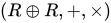
Intervals can be associated with points of the plane, and hence regions of intervals tin be associated with regions of the aeroplane. Generally, an interval in mathematics corresponds to an ordered pair (10,y) taken from the directly product R × R of real numbers with itself, where information technology is often causeless that y > ten. For purposes of mathematical structure, this restriction is discarded,[8] and "reversed intervals" where y − x < 0 are immune. And then, the drove of all intervals [10,y] can exist identified with the topological ring formed by the direct sum of R with itself, where addition and multiplication are defined component-wise.
The directly sum algebra has two ideals, { [x,0] : ten ∈ R } and { [0,y] : y ∈ R }. The identity element of this algebra is the condensed interval [1,1]. If interval [x,y] is not in one of the ideals, then it has multiplicative inverse [1/x, 1/y]. Endowed with the usual topology, the algebra of intervals forms a topological ring. The grouping of units of this band consists of iv quadrants determined by the axes, or ethics in this instance. The identity component of this group is quadrant I.
Every interval tin exist considered a symmetric interval around its midpoint. In a reconfiguration published in 1956 by M Warmus, the axis of "balanced intervals" [x, −ten] is used along with the axis of intervals [x,x] that reduce to a indicate. Instead of the direct sum , the ring of intervals has been identified[ix] with the split-complex number plane by Thousand. Warmus and D. H. Lehmer through the identification

- z = (x + y)/2 + j (ten − y)/2.
This linear mapping of the airplane, which amounts of a ring isomorphism, provides the airplane with a multiplicative structure having some analogies to ordinary complex arithmetics, such every bit polar decomposition.
Run into too [edit]
- Arc (geometry)
- Inequality
- Interval graph
- Interval finite element
- Interval (statistics)
- Line segment
- Partition of an interval
- Unit interval
References [edit]
- ^ a b "Intervals". world wide web.mathsisfun.com . Retrieved 2020-08-23 .
- ^ a b Weisstein, Eric W. "Interval". mathworld.wolfram.com . Retrieved 2020-08-23 .
- ^ "Interval and segment - Encyclopedia of Mathematics". world wide web.encyclopediaofmath.org. Archived from the original on 2014-12-26. Retrieved 2016-11-12 .
- ^ Rudin, Walter (1976). Principles of Mathematical Analysis . New York: McGraw-Hill. pp. 31. ISBN0-07-054235-10.
- ^ "Why is American and French notation dissimilar for open up intervals (x, y) vs. ]x, y[?". hsm.stackexchange.com . Retrieved 28 April 2018.
- ^ Kozyrev, Sergey (2002). "Wavelet theory as p-adic spectral analysis". Izvestiya RAN. Ser. Mat. 66 (2): 149–158. arXiv:math-ph/0012019. Bibcode:2002IzMat..66..367K. doi:10.1070/IM2002v066n02ABEH000381. S2CID 16796699. Retrieved 2012-04-05 .
- ^ Complex interval arithmetic and its applications, Miodrag Petković, Ljiljana Petković, Wiley-VCH, 1998, ISBN 978-3-527-40134-five
- ^ Kaj Madsen (1979) Review of "Interval analysis in the extended interval space" by Edgar Kaucher [ permanent dead link ] from Mathematical Reviews
- ^ D. H. Lehmer (1956) Review of "Calculus of Approximations" [ permanent dead link ] from Mathematical Reviews
Bibliography [edit]
- T. Sunaga, "Theory of interval algebra and its application to numerical assay" Archived 2012-03-09 at the Wayback Automobile, In: Research Association of Applied Geometry (RAAG) Memoirs, Ggujutsu Bunken Fukuy-kai. Tokyo, Nihon, 1958, Vol. 2, pp. 29–46 (547-564); reprinted in Japan Journal on Industrial and Practical Mathematics, 2009, Vol. 26, No. two-three, pp. 126–143.
External links [edit]
- A Lucid Interval by Brian Hayes: An American Scientist article provides an introduction.
- Interval computations website Archived 2006-03-02 at the Wayback Machine
- Interval computations research centers Archived 2007-02-03 at the Wayback Machine
- Interval Note by George Beck, Wolfram Demonstrations Projection.
- Weisstein, Eric W. "Interval". MathWorld.

Dimensional Analysis With Scientific Notation,
Source: https://en.wikipedia.org/wiki/Interval_(mathematics)
Posted by: vazquezanythat.blogspot.com
0 Response to "Dimensional Analysis With Scientific Notation"
Post a Comment